P4213
Sales Tax Guide for Farmers Market Vendors
This publication provides general guidance to help farmers market vendors understand when they may need to collect sales tax and which products may be exempt from sales tax. Sales tax is regulated by the State of Mississippi. While many agricultural products are exempt from sales tax, some products sold at farmers markets are taxable. Vendors who sell taxable products are responsible for collecting and reporting sales tax, just like any other retail business.
This guide provides an overview of common products sold at farmers markets:
- Fruit, vegetables, nuts, honey, and raw animal products
- Processed food products (including cottage foods) and meat
- Seeds, seedlings, animal feed, and fertilizer
- Nursery and ornamental plants
- Christmas trees, hay, straw, and fresh cut flowers
- Arts and crafts
However, this publication is intended only as a guide and not as legal advice. Vendors are encouraged to review the Mississippi Code Annotated, section 27-65-103, and contact the Mississippi Department of Revenue (DOR) for current guidance.
Common Products Sold
Fruit, Vegetables, Nuts, Honey, and Raw Animal Products
This category includes edible agricultural products sold in their raw, unprocessed state, such as fresh fruits, vegetables, honey (raw or filtered but not pasteurized), shelled and unshelled pecans or other nuts, and eggs.
Products are not exempt if the products were grown outside of Mississippi in another state.
Products are exempt if:
- the products were grown in Mississippi, and
- they are sold at:
- a farmers market certified by the Mississippi Department of Agriculture and Commerce (MDAC), or
- a non-certified farmers market that maintains a separate, designated area for vendors selling Mississippi-grown products.
A farmers market consists of two or more vendors selling agricultural products directly to consumers from booths, tables, or stands at a designated retail location. According to the Farmers Market Coalition, a market qualifies as a farmers market when at least one vendor sells agricultural products that they have grown, raised, or harvested. If you are unsure whether your farmers market is certified, you can view the list of MDAC-certified farmers markets here.
You can also learn more about the Mississippi Certified Farmers Market Program, including certification criteria and application information, through MDAC.
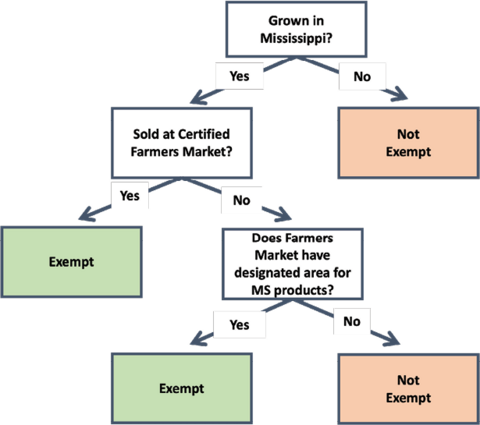
Note: For this category of products, the sales tax exemption generally applies to farm stands and roadside vendors, provided the unprocessed fruits or vegetables are grown in Mississippi by the vendor. However, this exemption generally does not apply when products are sold through an established retail store located on the farm.
Processed Food Products (Including Cottage Foods) and Meat
This category includes products such as meat, dairy products, jams, jellies, bread, cookies, popcorn, and sauces, etc.
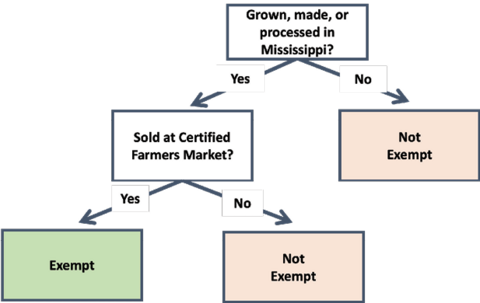
Products are not exempt if:
- the products were not grown, made, or processed in Mississippi.
- the products were processed in Mississippi but sold at a farmers market that is not certified by MDAC.
Products are exempt if:
- the products are grown, made, or processed in Mississippi (even if some ingredients, such as sugar used in jelly, are sourced from outside Mississippi), and
- they are sold at an MDAC-certified farmers market.
Seeds, Seedlings, Animal Feed, and Fertilizer
Retail sales of seeds and vegetable seedlings by farmers are exempt from sales tax. Examples include small tomato plants and other vegetable seedlings. This exemption generally applies to young vegetable plants rather than large, mature plants. Other types of plants, such as herb plants, are not included in this exemption and are generally considered nursery or ornamental plants, which are subject to sales tax. Animal feed for livestock, poultry, and fish is also exempt from sales tax. These products are generally exempt whether the farmers market is certified by MDAC.
Nursery and Ornamental Plants
Products such as ornamental plants, flowering plants, shrubs, nursery stock, wreaths, and bouquets are not exempt from sales tax. If these items are sold at a farmers market, vendors must collect sales tax.
Christmas Trees, Hay, Straw, and Fresh Cut Flowers
This category includes products cut from plants, such as hay, straw, and fresh cut flowers.
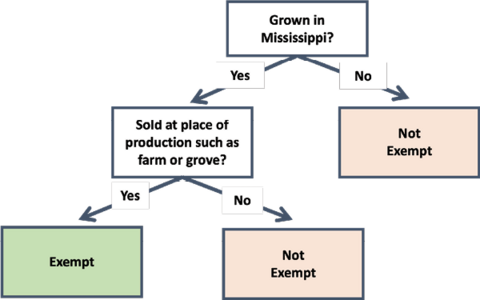
Products are not exempt if:
- the products were grown outside Mississippi in another state, or
- the products are sold away from the place of production, such as at a farmers market.
Products are exempt if:
- the products were grown in Mississippi, and
- the products are sold at the place of production, such as the farm, garden, or grove, in their original condition.
Arts and Crafts
Arts and crafts products are subject to sales tax. Vendors selling arts and crafts at farmers markets are required to collect sales tax regardless of the size of their operation.
Some examples are below.
- A vendor sells fresh fruits and vegetables grown in Mississippi at an MDAC-certified farmers market → The products are exempt from sales tax.
- A vendor sells fresh fruits and vegetables grown in Mississippi at a non-certified farmers market with a separate area for Mississippi-grown products → The products are exempt from sales tax.
- A vendor sells fresh fruits and vegetables grown in another state at an MDAC-certified farmers market → The products are not exempt from sales tax. The vendor must collect sales tax.
- A vendor sells homemade cookies at an MDAC-certified farmers market → The products are exempt from sales tax.
- A vendor sells homemade cookies at a non-certified farmers market → The products are not exempt from sales tax. The vendor must collect sales tax.
- A vendor sells small tomato and cucumber plants at a farmers market → These products are exempt from sales tax.
- A vendor sells ornamental plants at a farmers market → The products are not exempt from sales tax. The vendor must collect sales tax.
- A vendor sells arts and crafts at a farmers market → The products are not exempt from sales tax. The vendor must collect sales tax.
Who Is Responsible for Collecting and Reporting Sales Tax?
The vendor is generally responsible for collecting and reporting sales tax. In some cases, a farmers market or organization may operate as the “promoter of an event.” In these situations, the market may:
- inform vendors about sales tax requirements,
- provide forms for reporting sales tax,
- collect the tax from vendors, and
- submit the taxes to the state.
However, most farmers markets do not operate this way. In most cases, vendors are responsible for collecting and reporting sales tax on taxable products. If a vendor is required to collect sales tax and does not have a permanent business location outside their residence, Mississippi law requires the vendor to pay a $500 bond to secure tax liabilities.
Vendors who collect sales tax must file a sales tax return and send the collected taxes to the DOR.
For current information and guidance, vendors are encouraged to contact the DOR.
Resources
Mississippi Code Annotated, Agriculture Section 27-65-103
Publication 4213 (POD-08-26)
By Elizabeth Canales, Associate Professor, Agricultural Economics.
The Mississippi State University Extension Service is working to ensure all web content is accessible to all users. If you need assistance accessing any of our content, please email the webteam or call 662-325-2262.
Download
P4213
Sales Tax Guide for Farmers Market Vendors
225.53 KB
Departments
Authors
-
 Associate Professor
- Agricultural Economics